Dreamotion 1.0
Generating expressive, precise, and natural full-body motion from open-ended text.
ByteDance Intelligent Creation
2Select Vincent action
3Enter prompt and generate
4View the generated motion!
1Open creative canvas
2Open 3D director studio
3Enter the prompt
4View the generated motion!
Demo Gallery
Explore diverse motions generated by Dreamotion!
Hover to pause · Click any video to enlarge
Applications
Diverse downstream applications.
Dreamotion can support diverse downstream applications, including controllable human video generation and scalable motion data generation for embodied intelligence.
Text-to-character video
Text prompt→Generated motion+Character & background references→Generated video
Generated motion provides explicit movement guidance for reference-to-video generation, while character and background references control appearance and scene context.
Text prompt · Case 011
“Perform Tai Chi cloud hands in front of the body, slowly shifting the weight from side to side.”
Text prompt · Case 021
“First walk forward, then spread both arms in a welcoming gesture, and finally raise one hand to greet.”
Generated motion · Case 012
Generated motion · Case 022
Visual references3
 Character
 Background
Generated video · Case 014
Generated video · Case 024
Text-to-robot motion
Text prompt→Generated motion→Motion retargeting→Robot motion
Human motion generated from open-ended prompts can be retargeted to humanoid embodiments, creating scalable motion data for embodied agents.
“Perform a set of standard squats.”
Generated motion
Retarget→GMR
Robot motion
“Step forward and extend a hand in welcome.”
Generated motion
Retarget→GMR
Robot motion
Key capabilities
A broader motion vocabulary.
Dreamotion makes text-to-motion generation more practical for real-world applications by addressing challenging scenarios that remain difficult for prior models.
01
Basic actions
“Drum with both hands, then tap the feet to the beat.”
“Jog lightly down the stairs.”
02
Compositional actions
“First step forward, then spread both hands, and finally point forward with one hand.”
“Run all the way over, pick up something from the ground, then walk back.”
03
Long-tail semantics
“Perform Tai Chi cloud hands in front of the body, slowly shifting the weight from side to side.”
“Perform a sequence of tricks with yo-yo and then catch it.”
04
Detailed hand gestures
“Raise both hands in front of the chest and extend two fingers on each hand in a V sign.”
“Raise one thumb to show approval.”
05
Emotional expression
“Lean back half a step in surprise, covering the wide-open mouth with both hands.”
“Clench both fists and wave the arms excitedly in celebration.”
06
Fine-grained control
“First pretend to open a box with both hands, then present it forward.”
“Pretend to hold a steering wheel with both hands and turn it left and right.”
Evaluation
Leading human preference.
We evaluate Dreamotion on 674 held-out prompts under a unified human evaluation protocol. Blind pairwise comparisons measure overall user preference. Five-dimensional MOS ratings provide a multidimensional assessment of generation quality, while the overall usability rate separately reflects practical usability.
Human preference ranking
10,507 judgments were collected through blind, side-by-side comparisons and aggregated into an Elo-style global ranking of Dreamotion and recent state-of-the-art text-to-motion models.
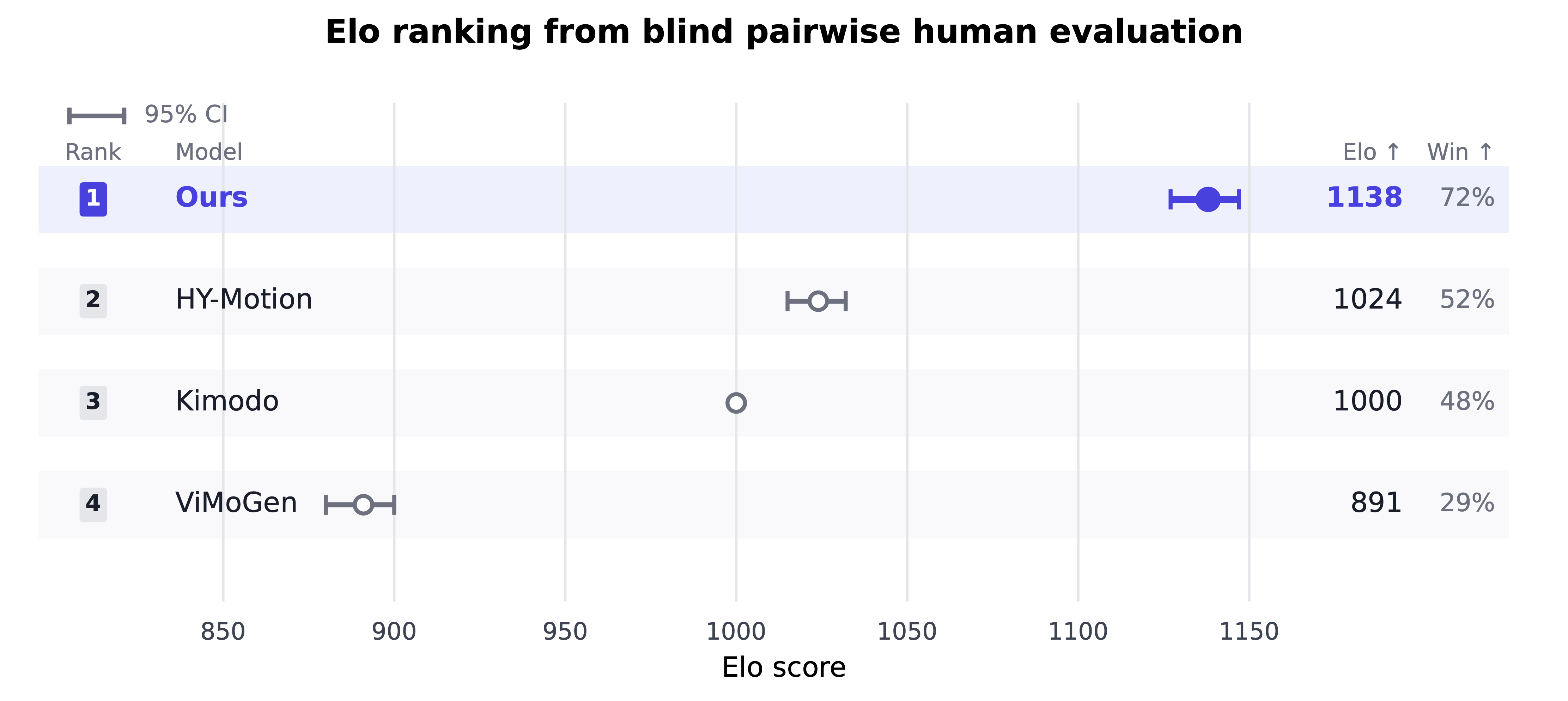
Rank-1 with 72% win rate
Multi-dimensional mean opinion score
Five-dimensional MOS evaluates generated motions across five complementary aspects on a 1-to-5 scale. The overall usability rate measures practical usability, representing the proportion of motions that score at least 3 across all five dimensions.
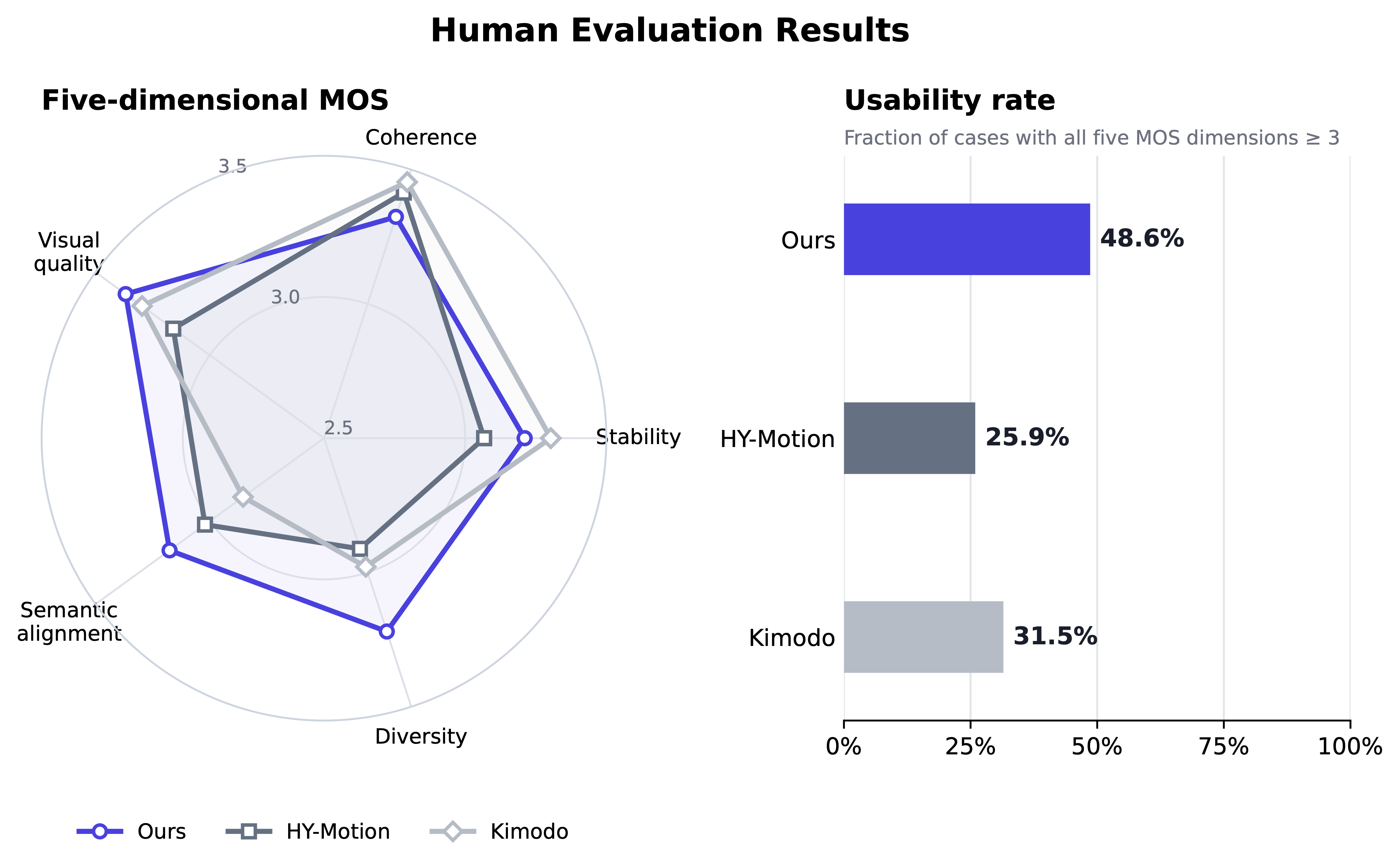
48.6% strictly usable
Data engine
Hierarchical data, targeted growth.
Dreamotion scales data hierarchically and purposefully. Three data tiers play complementary roles: broad coverage builds semantic breadth, targeted refinement repairs capability gaps, and high-fidelity motion capture strengthens fine-grained alignment. The action space is organized by a taxonomy, where recurring model failures guide targeted data expansion.
3MMotion clips
5K+Motion hours
19L1 action domains
3K+Leaf action categories
Examples across three data tiers
Each motion is paired with multiple textual views, ranging from concise action summaries to detailed, multilingual descriptions and user-style prompts.
In-the-wild motion
A large-scale motion corpus is built by recovering SMPL-X motion from in-the-wild videos and pairing it with VLM-generated captions, providing broad coverage of real-world actions and language.
Attempting to climb a tree trunk
Targeted synthesis
A feedback loop identifies under-covered semantic categories, which are supplemented with videos generated by Seedance 2.0. These videos provide cleaner, more controllable motion data which expand long-tail semantic coverage and improve motion coherence and stability.
A traffic police officer turns their body and signals a turn
Optical MoCap
Precise optical motion capture is paired with human-authored descriptions to provide high-fidelity motion and semantic supervision, strengthening realism, expressiveness, and fine-grained instruction following.
She starts from a standing position, spreads her arms straight out to both sides, rotates one full circle counterclockwise centered on herself, turns her head along with her body, then retracts her arms and stands still.
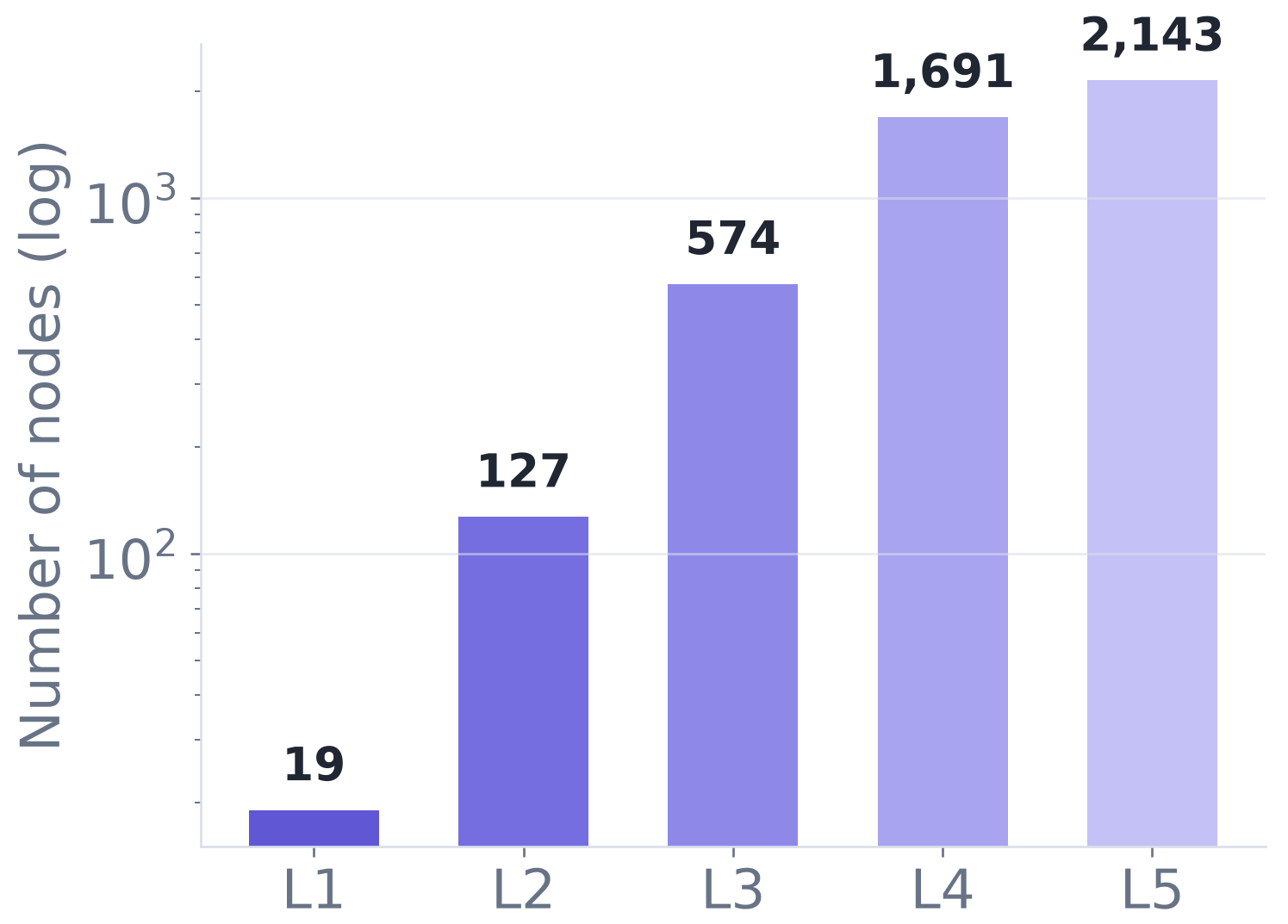
Action Taxonomy
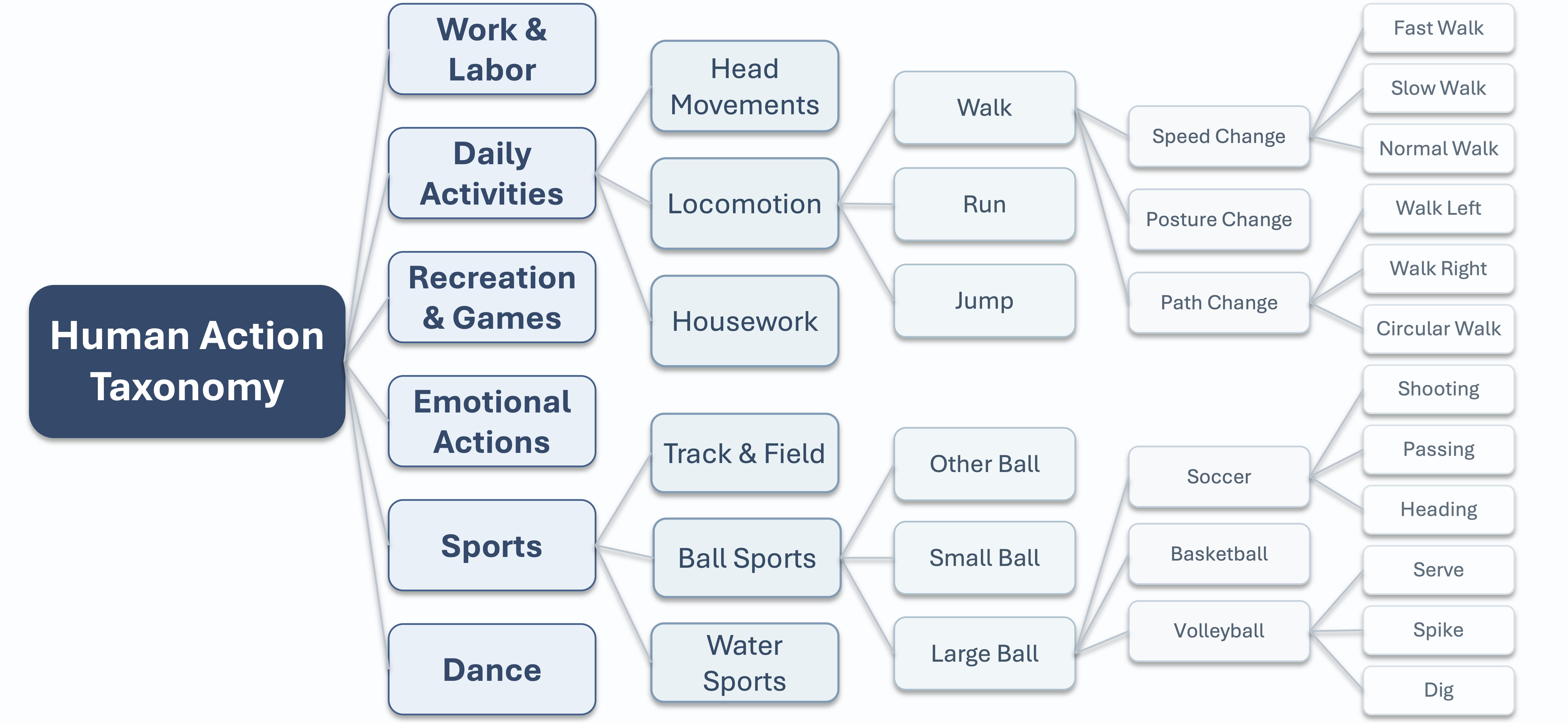
A five-level L1–L5 hierarchy for organizing motion semantics space into structured taxonomy. A partial view is shown below.
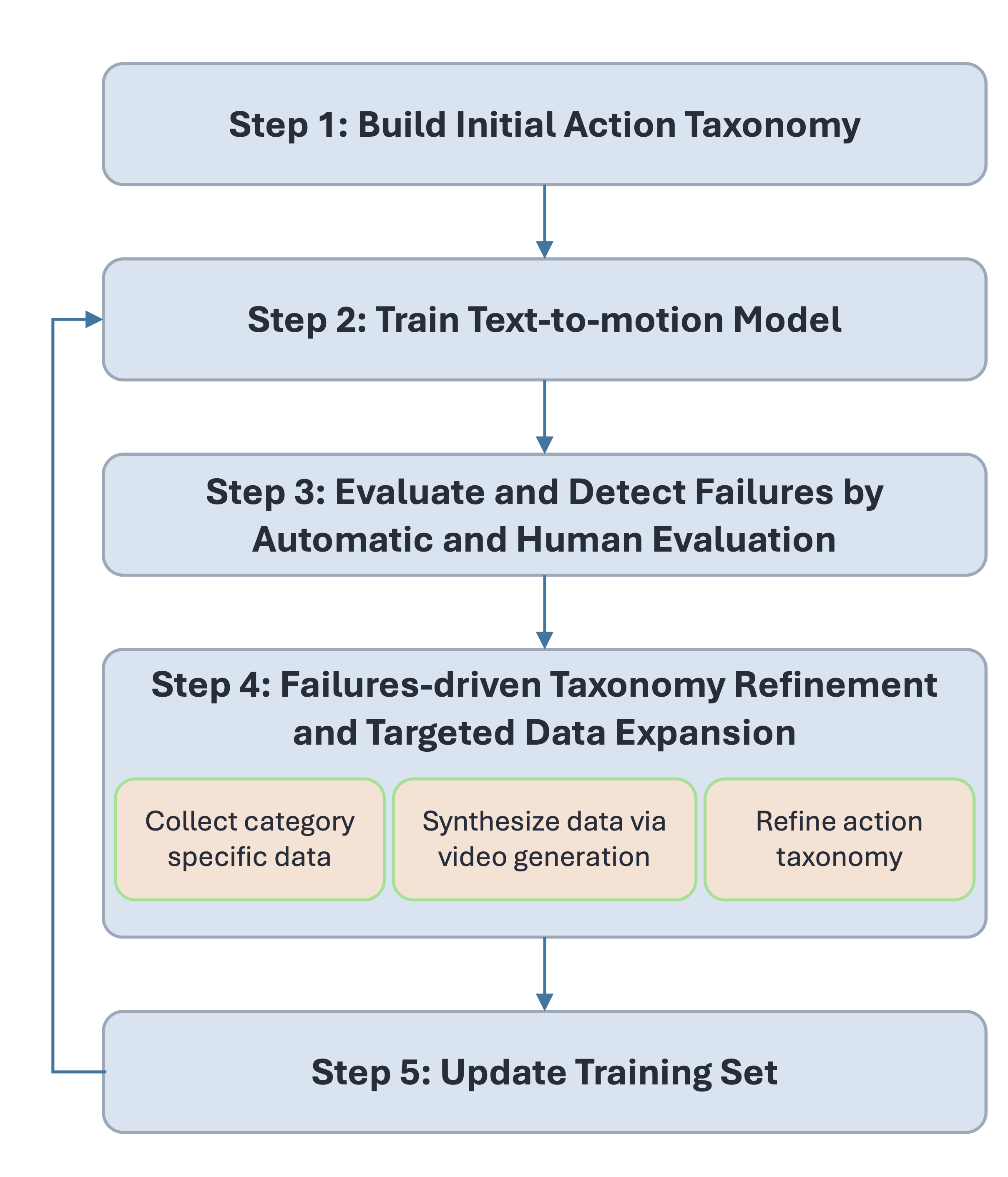
Feedback loop
Model failures reveal capability gaps and drive targeted data expansion.
Taxonomy scale
19 L1 domains, 3,000+ L4/L5 leaf actions.
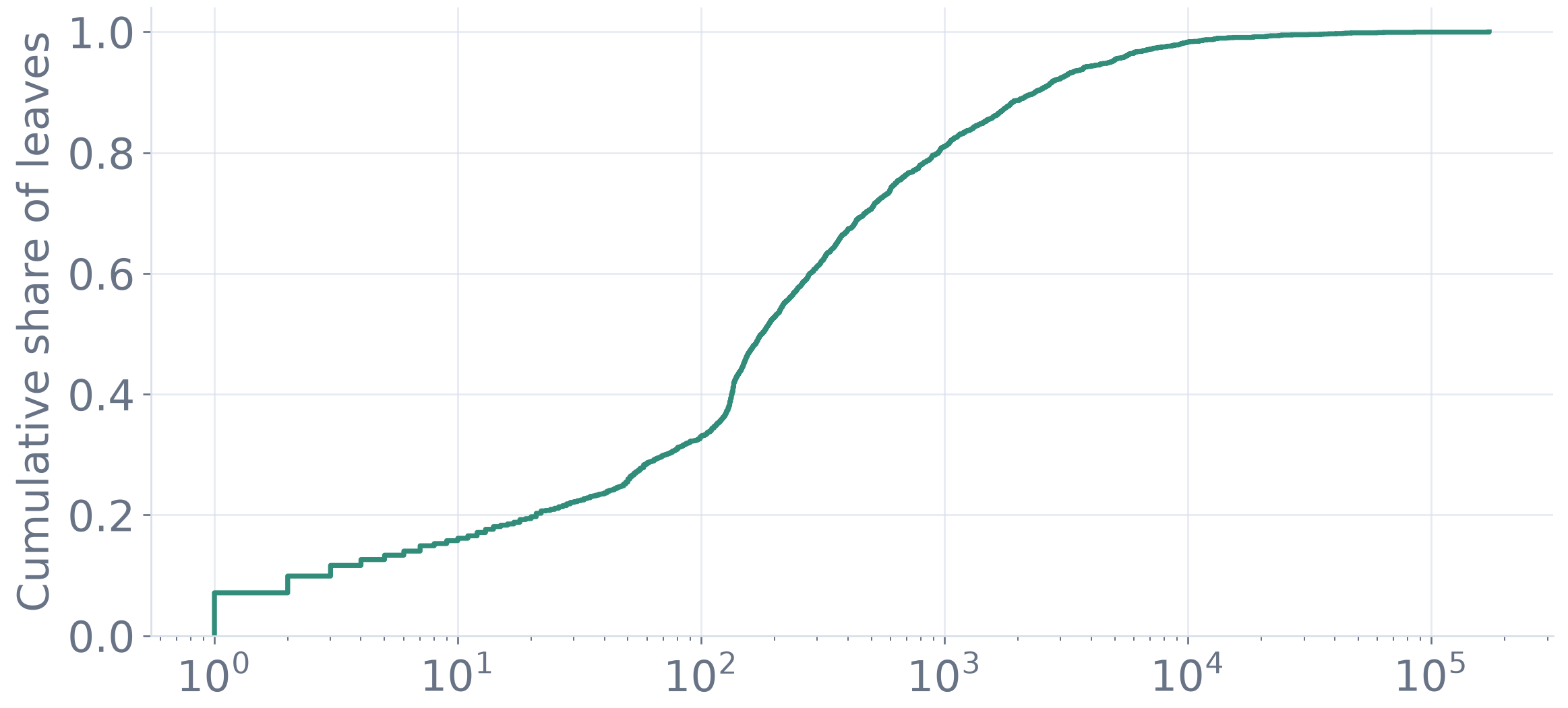
Long-tail coverage
85%+ leaf categories have at least 10 samples.
Method
Structured generation,
progressive learning.
Dreamotion combines structured motion generation with progressive training to support more reliable full-body motion generation.
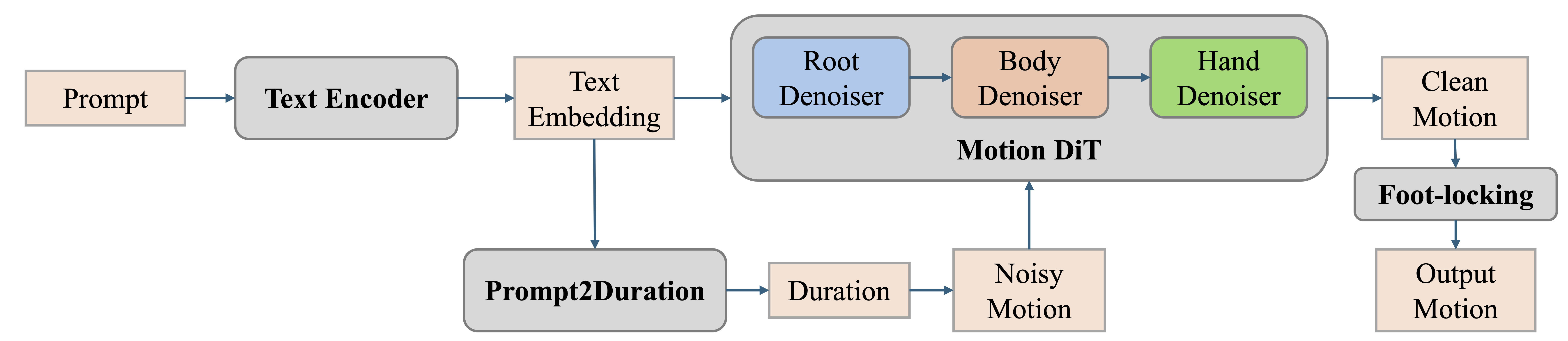
Model
Root–Body–Hand cascade
Dreamotion generates full-body motion hierarchically from root trajectory to body dynamics and finally hand-level details, in order to preserve fine-grained details while maintaining overall consistency.
Training
Pre-Training → Continued Training → Supervised Fine-Tuning
The training curriculum progresses through three corresponding data tiers, moving from large-scale generalization to targeted refinement and high-fidelity alignment.
PT · GeneralizeData: Broad-coverageBroad text-motion generalization
CT · RepairData: Quality-refinementMotion quality and capability repair
SFT · AlignData: High-fidelityRealism and fine-grained alignment
Scaling behavior
Scaling data and model capacity.
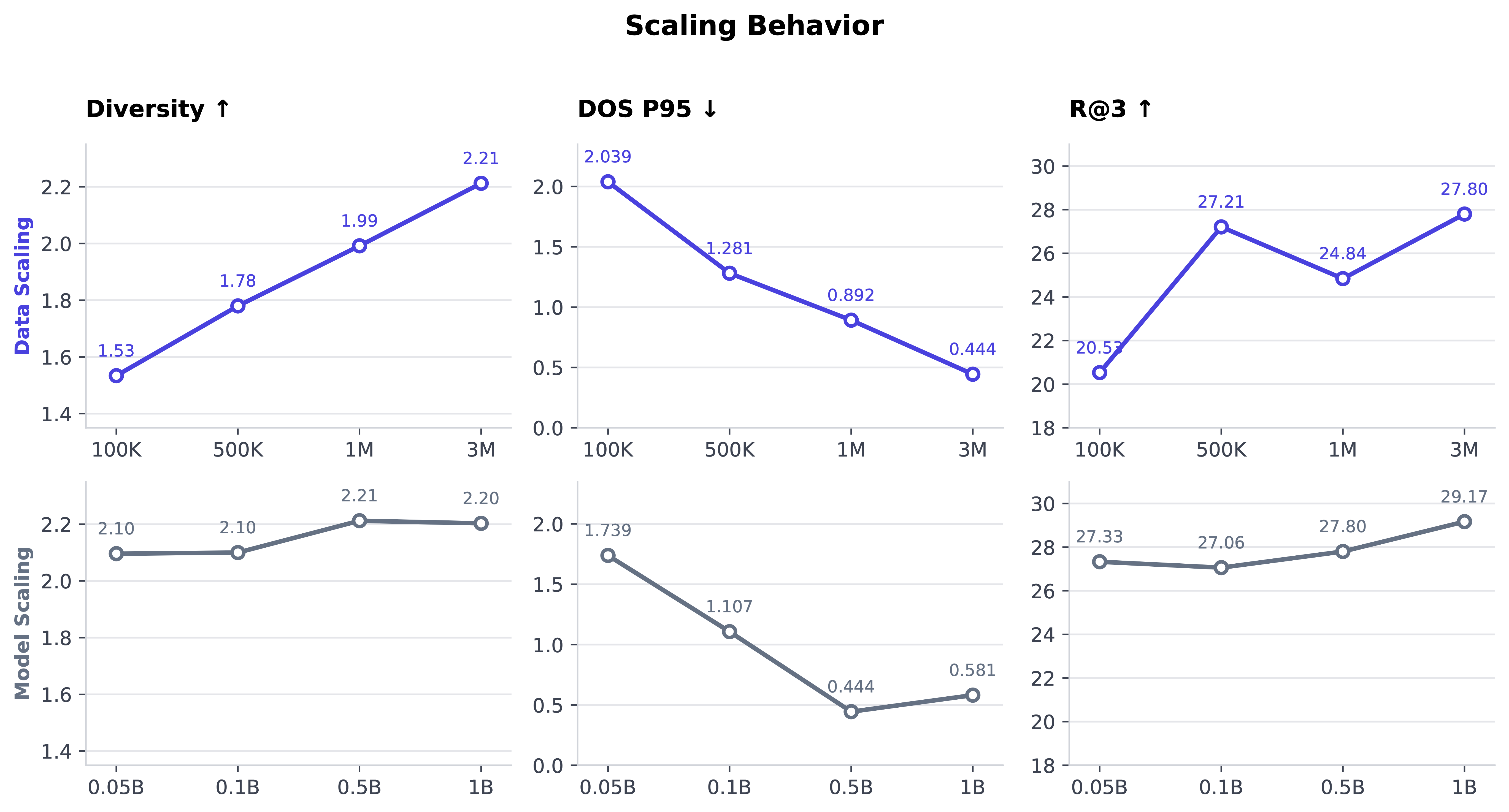
Automatic evaluation reveals how data and model scaling affect the generation performance. Diversity measures motion variety, DOS P95 captures severe high-frequency artifacts, and R-Precision@3 measures text-motion alignment.
Broader data leads to consistent gains in diversity, semantic alignment, and high-frequency motion quality.
Larger models improve overall performance up to 0.5B, after which gains largely saturate except for slight improvements in alignment.