Technical Report Demo
TTSonic
A Unified Framework for Composable and Controllable Speech Generation
Paper
Abstract
Modern text-to-speech (TTS) systems can synthesize natural and expressive speech, yet a practical speech foundation model must go beyond naturalness to offer stable quality, precise controllability, and a broad set of composable capabilities within a unified framework.
We present TTSonic, a unified speech generation model that supports zero-shot TTS, voice cloning, prosody cloning, instruction following, voice conversion, and cloning from noisy reference speech. Rather than relying on separate task-specific models, TTSonic accommodates diverse conditioning signals, including text, natural-language instructions, reference speech, and text-described timbre, within the same model framework.
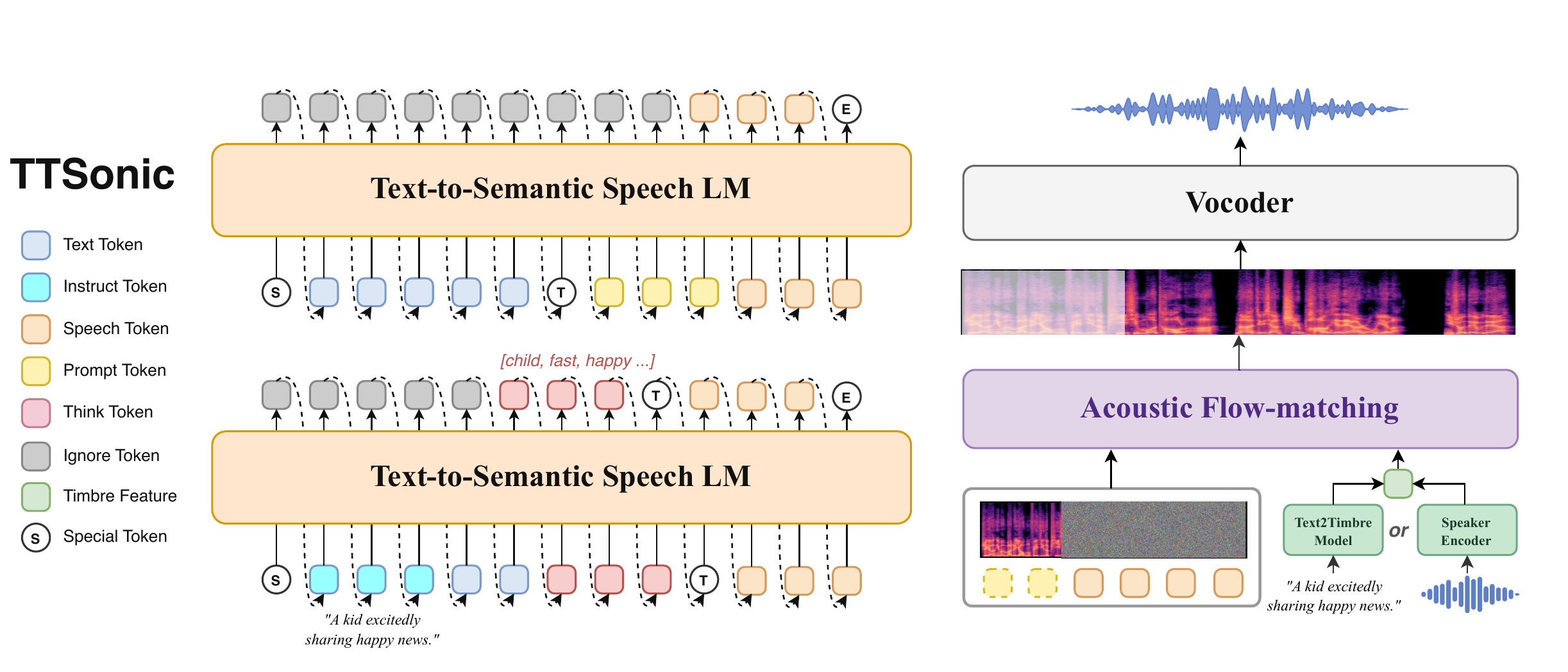
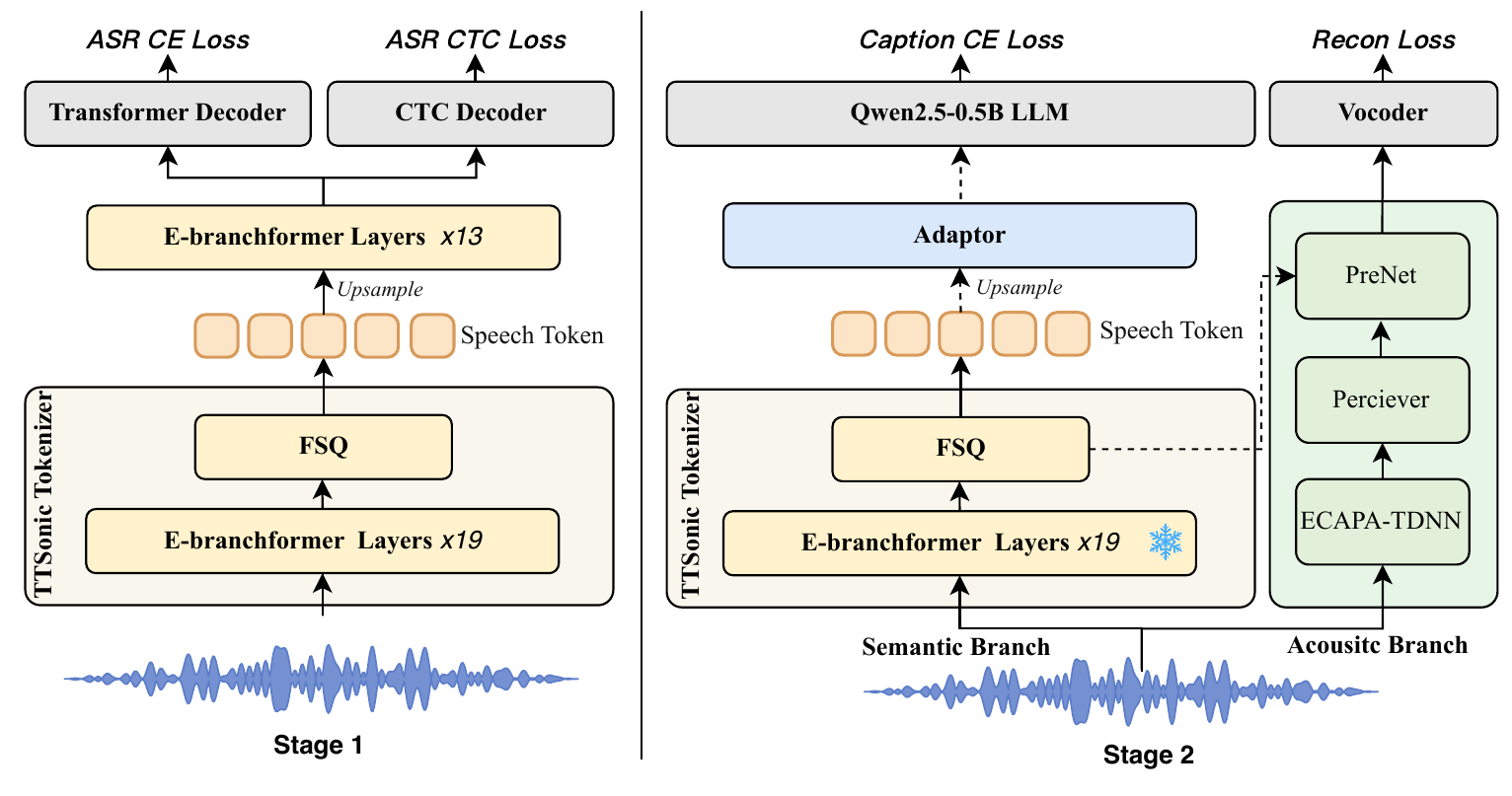
Specifically, we develop a semantic--acoustic disentangled speech tokenizer through ASR-supervised semantic learning and reconstruction-guided generative refinement. Serving as the representational foundation of our unified framework, the tokenizer enables the Text-to-Semantic autoregressive model to focus on semantic and prosodic planning, while the acoustic flow-matching model specializes in high-quality speech rendering under diverse acoustic and timbre conditions.
Building on this framework, we incorporate CoT-guided instruction-following planning and Text2Timbre voice design to support controllable speech generation.
Experiments across zero-shot synthesis, multilingual and cross-lingual TTS, instruction following, voice design, voice conversion, and noisy-reference cloning demonstrate the competitive performance and broad applicability of TTSonic.
Architecture
Method Overview
Speech Enhancement
Reconstruct clean, intelligible speech from codec tokens while filtering background noise, reverberation, and other acoustic degradations.
Voice Conversion
Transfer the target speaker's timbre while preserving the source speech content.
Voice Cloning
Generate new speech from a reference prompt and text while preserving the reference speaker's voice.
Prosody Cloning
Clone the prosody of the Prompt audio and express it with the Target Voice timbre.
Instruction Following
Follow natural-language instructions for speaker traits, speaking style, emotion, and prosody.
Long-form Instruction Following
Maintain instruction adherence, speaker consistency, and expressive prosody throughout long-form narration.
All texts and instructions used in this section were generated by a large language model.
Disclaimer
The content provided above is for academic purposes only and is intended to demonstrate technical capabilities. Some examples are sourced from the internet. If any content infringes on your rights, please contact us to request its removal.