Hubbard Model Examples
This page expands the Hubbard-model workflows on:
- a \(16 \times 4\) lattice with the ACE ansatz,
- a \(16 \times 8\) lattice with the SCALE ansatz.
The reusable scripts remain under docs/examples/hubbard/, and the full commands are expanded below.
Hubbard Hamiltonian
The workflows target the standard square-lattice Hubbard Hamiltonian
In these examples --model hubbard selects this Hamiltonian, --boundary1 pbc --boundary2 pbc makes the lattice fully periodic, and --U 8 sets the target interaction strength for the final VMC relaxation. The optimizer setup follows arXiv:2507.02644, the ansatz setup follows arXiv:2604.25775, and the smaller-\(U\) determinant warm-start strategy follows arXiv:2507.10705.
Experiment workflows
Both final VMC relaxations use periodic boundary conditions in both directions (--boundary1 pbc --boundary2 pbc) and optimize the standard Hubbard Hamiltonian at \(U=8\). The \(16\times8\) workflow uses a weak pinning field only in the determinant warm-start stage; the final SCALE relaxation and the GFMC projection do not include a pinning field.
16x4 PBC, U=8: ACE ansatz
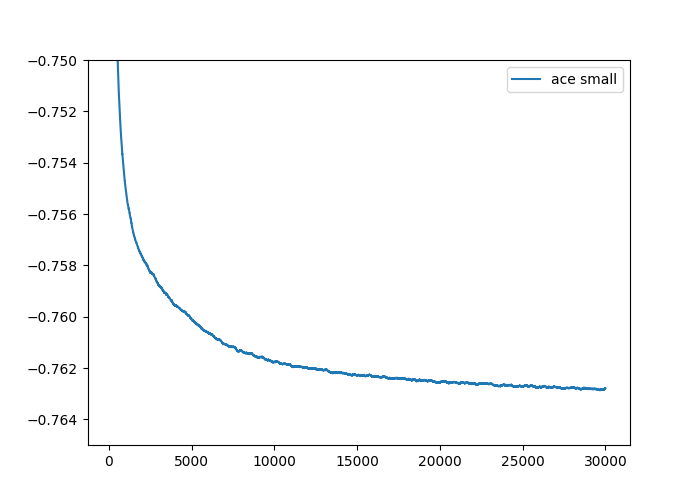
This workflow uses a \(16\times4\) fully periodic lattice with \(N=56\) electrons. Stage 1 trains a one-determinant tensor ansatz at \(U=4\) with Adam. Stage 2 restores that checkpoint and relaxes an ACE ansatz at \(U=8\) with MARCH stochastic reconfiguration. No pinning field is used in either stage.
Stage 1: determinant warm start at U=4
python main.py \
    --output outputs/hubbard/16_4_pbc_U8/tensor_ndet1 \
    --L1 16 \
    --L2 4 \
    --particles 56 \
    --U 4 \
    --model hubbard \
    --steps 5000 \
    --network_name tensor \
    --boundary1 pbc \
    --boundary2 pbc \
    --save_frequency 5000 \
    --use_x64 \
    --mcmc_step 128 \
    --mode adam \
    --lr 5e-2 \
    --ndet 1 \
    --reduce 200 \
    --seed 100 \
    --fast_update \
    --batchsize 4096
Stage 2: ACE relaxation at U=8
python main.py \
    --restore outputs/hubbard/16_4_pbc_U8/tensor_ndet1 \
    --restore_ndet 1 \
    --output outputs/hubbard/16_4_pbc_U8/ace_small_N5e-1_fromU4 \
    --L1 16 \
    --L2 4 \
    --particles 56 \
    --U 8 \
    --model hubbard \
    --steps 30000 \
    --network_name ace \
    --boundary1 pbc \
    --boundary2 pbc \
    --save_frequency 2000 \
    --use_x64 \
    --mcmc_step 160 \
    --mode march \
    --norm 5e-1 \
    --lr_start 1000 \
    --lr0 4000 \
    --ndet 1 \
    --hidden 128 \
    --layers 12 \
    --reduce 200 \
    --seed 100 \
    --precision tf32 \
    --batchsize 4096
16x8 PBC, U=8: SCALE ansatz
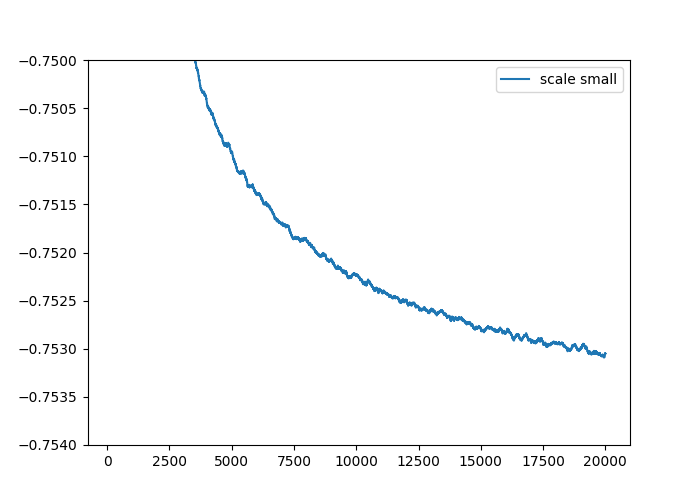
This workflow uses a larger \(16\times8\) lattice with \(N=112\) electrons. Stage 1 trains a one-determinant tensor ansatz at \(U=4\) with a weak temporary pinning field. This pinning field is only used to prepare a useful warm-start checkpoint. Stage 2 restores the checkpoint and relaxes the standard \(U=8\) Hubbard model with the scale ansatz, with no pinning field. Stage 3 starts from the final SCALE checkpoint and applies GFMC projection to the same fully periodic \(U=8\) Hamiltonian.
Stage 1: pinned determinant warm start at U=4
The temporary field is selected by --hm 0.05 --htype vert_spin_hole --lambda_h 8. These flags appear only in this warm-start command.
python main.py \
    --output outputs/hubbard/16_8_pbc_U8/tensor_stripe_U4 \
    --L1 16 \
    --L2 8 \
    --particles 112 \
    --U 4 \
    --hm 0.05 \
    --htype vert_spin_hole \
    --lambda_h 8 \
    --model hubbard \
    --steps 5000 \
    --network_name tensor \
    --boundary1 pbc \
    --boundary2 pbc \
    --save_frequency 5000 \
    --use_x64 \
    --mcmc_step 256 \
    --mode adam \
    --lr 5e-2 \
    --ndet 1 \
    --reduce 500 \
    --seed 100 \
    --fast_update \
    --batchsize 4096
Stage 2: SCALE relaxation at U=8
The final VMC relaxation removes the temporary pinning field: there is no --hm, --htype, or --lambda_h in this command.
python main.py \
    --restore outputs/hubbard/16_8_pbc_U8/tensor_stripe_U4 \
    --restore_ndet 1 \
    --output outputs/hubbard/16_8_pbc_U8/scale_small_N5e-1_fromU4 \
    --L1 16 \
    --L2 8 \
    --particles 112 \
    --U 8 \
    --model hubbard \
    --steps 20000 \
    --network_name scale \
    --boundary1 pbc \
    --boundary2 pbc \
    --save_frequency 2000 \
    --use_x64 \
    --mcmc_step 320 \
    --mode march \
    --norm 5e-1 \
    --lr_start 1000 \
    --lr0 8000 \
    --ndet 1 \
    --hidden 256 \
    --MLP_hidden 512 \
    --MLP_layers 4 \
    --reduce 500 \
    --seed 100 \
    --fast_update \
    --batchsize 4096
Stage 3: GFMC projection from the SCALE checkpoint
The GFMC stage reads the latest checkpoint in the Stage 2 output directory and projects the same fully periodic \(U=8\) Hubbard Hamiltonian. For this run, the GFMC projection gives an energy of \(-0.75628(2)\).
python main.py \
    --output outputs/hubbard/16_8_pbc_U8/scale_small_N5e-1_fromU4 \
    --L1 16 \
    --L2 8 \
    --particles 112 \
    --U 8 \
    --model hubbard \
    --steps 5000 \
    --network_name scale \
    --boundary1 pbc \
    --boundary2 pbc \
    --use_x64 \
    --mcmc_step 320 \
    --mode gfmc \
    --ndet 1 \
    --hidden 256 \
    --MLP_hidden 512 \
    --MLP_layers 4 \
    --reduce 448 \
    --seed 100 \
    --fast_update \
    --batchsize 4096
References
- arXiv:2507.02644 — reference for the optimizer setup used by these examples.
- arXiv:2604.25775 — reference for the ansatz setup used by these examples.
- arXiv:2507.10705 — reference for the smaller-\(U\) warm-start strategy.